

The Decisive Lever for Africa’s Economic Transformation
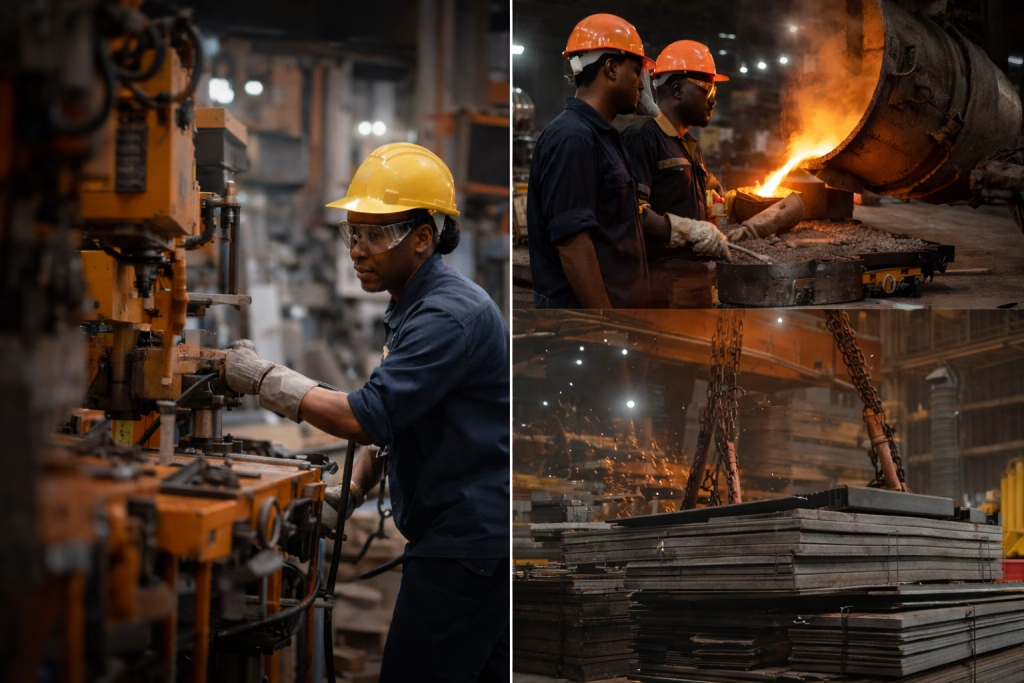
African economic integration has entered a new phase. With the progressive implementation of the African Continental Free Trade Area (AfCFTA), the continent now has a unified framework designed to boost intra-African trade, strengthen regional value chains, and accelerate structural economic transformation.
However, one reality remains clear: trade alone is not enough.
The fundamental issue is industrialization.
From Exporting Raw Materials to Creating Value
Historically, a large share of African exports has consisted of minimally processed raw materials. This dependency limits value capture, exposes economies to external shocks, and constrains the creation of skilled employment.
Industrialization changes the equation.
Processing locally means:
- Increasing domestic value addition
- Strengthening the competitiveness of African firms
- Creating sustainable and skilled jobs
- Diversifying exports
- Reducing reliance on imported manufactured goods
The AfCFTA opens the continental market.
Industrialization enables Africa to fully capitalize on it.
AfCFTA: An Opportunity That Must Be Structured
The creation of a continental market of over one billion consumers represents a historic opportunity. Yet without sufficient productive capacity, trade liberalization risks benefiting already industrialized economies more than emerging ones.
For integration to be balanced and sustainable, several conditions must be met:
- Development of industrial and logistics infrastructure
- Access to productive financing
- Strengthening technical and vocational skills
- Harmonization of standards and regulations
- Effective coordination between public and private sectors
The objective is not merely to increase trade flows, but to build strong intra-African value chains.
Industrialize to Integrate Sustainably
Successful trade integration rests on a solid productive base. Without industry, there is no transformation; without transformation, there is no true continental competitiveness.
Africa possesses:
- A rapidly expanding market
- A young and dynamic population
- Abundant natural resources
- Growing technological potential
The challenge now is to convert these advantages into interconnected regional industrial capacities.
The Strategic Role of THE NIL AFRICA
In this context, THE NIL AFRICA can actively contribute to industrialization and economic integration by:
1. Connecting Industrial Ecosystems
Facilitating partnerships between manufacturers, investors, financial institutions, and public decision-makers.
2. Structuring Strategic Intelligence
Providing sectoral analysis and actionable insights to support informed investment and industrial decision-making.
3. Promoting Intra-African Value Chains
Highlighting cross-border industrial synergies and fostering regional production collaboration.
4. Supporting Execution
Moving beyond narrative to help structure concrete, measurable, and results-driven initiatives.
Conclusion: Produce to Prosper
Africa cannot remain solely a consumer market.
It must become an integrated production space.
The AfCFTA marks a new era.
Industrialization will be its engine.
The future of intra-African trade will depend on the continent’s ability to produce, transform, and trade at regional scale.